The enemy of success is not failure. The enemy of success is mediocrity, complacency, inaction.
Timing to engage a sales agency is like timing to have a baby, it’s never right. We need more money, we need more staff to deliver, we need a better office, we need a better economy, we need the product to be perfect. We need those, when this happens, if that.
You get stuck in mediocrity, complacency, inaction and never execute. The anxiety of failure gives you a shut down response. Luckily sales peeps are really good at dealing with failure.
I always say start sales at 40% certainty. Every step towards a goal reduces uncertainty, and by 70% we need to push the accelerator or the brake.
Most business owners know they need more sales. But hiring, training and managing salespeople is expensive, difficult and risky. There are ten broad reasons a company is never ready.
They look like ten separate problems. They are one problem, which is not enough sales activity. I wrote about what a thin pipeline does to a small business in The Face Octopus, and the same thing is at work here. The core problem is just lack of sales.
“We’re not ready” is also what a ‘no’ sounds like when it’s polite. Matt Dixon and Ted McKenna analysed 2.5 million sales conversations for their book The JOLT Effect and found that around half of all lost deals ended in no decision. A competitor didn’t win them. The buyer never acted. More than half of those losses were rooted in fear of failure. The buyer is afraid of getting it wrong, and “we’re not ready” is the most respectable way to say so. Your Real Challenge of “No Decision”: The Psychology of Buyer Indecision and How Top Sellers Beat It +2
1. We’re not ready to grow
The product, people or capacity aren’t in place. But the only way to find out what the market wants, who will buy and what they’ll pay is to have sales conversations. A business that waits until it’s ready to start selling is guessing at all three. Selling first tells you what the business needs, and what to fix.
2. We’re not ready to invest
This is the chicken and egg of sales. You need money to turn sales on, and sales is what provides the money. Waiting for the cash means waiting for the exact thing you’re trying to avoid. A shortage of money also narrows your thinking, which I covered in the Face Octopus. It takes money to make money.
3. We’re not ready to hand over sales
The founder knows the product better than anyone and doesn’t trust someone else with a customer. So they hand over a slice at a time. A marketing agency here, an SEO provider there, a telemarketing outfit for the calls. Each one delivers a part of the sales process and none of them owns the sale. The founder is left as the glue, taking the meetings, closing the deal and fixing what got promised along the way. That is tranche sales at small business scale, and every extra provider is another barrier between your customer and a signed contract.
Economists William Samuelson and Richard Zeckhauser ran a series of experiments showing that people disproportionately stick with the status quo, and the effect held in real choices like health plans and retirement programs. Doing sales yourself and patching the gaps with specialists is the default, and the default wins. repec
The question to ask any provider is who owns the outcome from first call to signed contract. Outsold runs the whole cycle, from prospecting through to account management.
4. We’re not ready to engage an agency
They don’t yet trust us, or can’t see why they need us. Fair. Hiring, training and managing salespeople is risky, and plenty of founders have been burned. Dixon’s research also found that scaring a customer into action gives them more to worry about, and they end up doing nothing. So I don’t push. Start small and judge us on what we do. customerthink
5. We need a better economy. Ranjay Gulati, Nitin Nohria and Franz Wohlgezogen studied 4,700 public companies through the recessions of 1980, 1990 and 2000. About 9% flourished, beating competitors by at least 10% in sales and profit growth. Cutting costs hardest was no safer, as only 21% of companies that cut faster than their rivals did better when times improved. The best performers combined defensive and offensive moves. Waiting for a better economy is not a strategy. docs.google.com +2
6. The product has to be perfect. Colin Powell is known for his 40/70 rule: don’t decide with less than 40% of the information you need, and by about 70% you should decide, because you may lose the opportunity. Nobody waits for 100%. insideindianabusiness
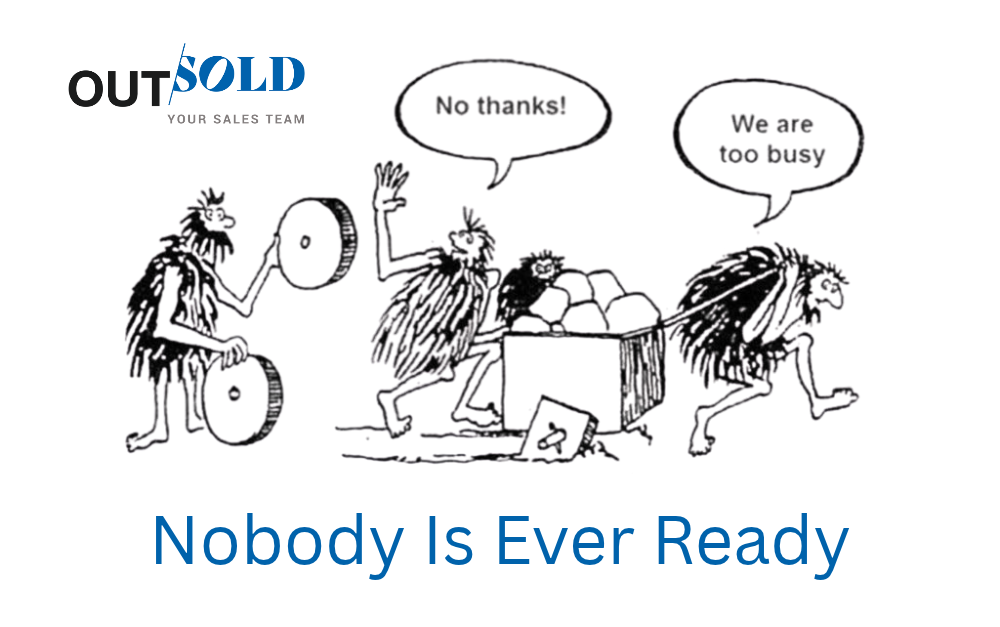
7. We’re too busy. See the cartoon.
8. We’ve been burned before. A bad hire or a bad agency leaves a mark. That is fear of failure again, and the answer is a smaller first step with a clear point to stop.
9. We need to run it past someone. The research found that as stakeholders multiply, deals get harder to close and more prone to ending in no decision. If the decision needs other people, get them in the room early. challengerinc
10. Let’s see how next quarter goes. A vague “we’ll see” costs a seller more than a plain no, and the average seller loses 40% to 60% of their qualified pipeline to no decision. If nothing changes between now and then, it’s a no. podchaser
What we can do about it
Pick the one that matches what’s holding you back.
Not sure the business is ready, or that the numbers stack up: Outsold Sales Ready. For people that don’t know what they need for sales. A working session on how your sales actually runs today. You get a clear verdict, the biggest blockers in order, and a recommendation on whether to invest in sales now, later or not at all.
Not sure the opportunity is real: Outsold Sales Viability. About a weeks work to test market viability, a short step before any sales delivery. We define the commercial opportunity and test your assumptions, then release delivery in stages as it proves out.
Want to keep control while you build it: Sales Coaching or Fractional Commercial Partner. One hour a week, run like a sales meeting. You stay in the seat while we build the process around your strengths, and you hand over when it’s proven.
Want the sales process written down: Playbook Build. A short, focused build of your sales strategy, assets and process, so it stops living in your head.
Want the work done: sales outsourcing. We recruit, train and manage a salesperson for you, or run the sales function as an outsourced team.
Tell me where you’re stuck and I’ll tell you which one fits, or if none do.
Make the decision
Maybe is the most expensive answer, for you and for me. It costs us both time and gets neither of us anywhere.
The cart still moves on square wheels. It just moves slowly, and everyone pushing it is too busy to change the status quo.
The research behind this
Matthew Dixon and Ted McKenna, The JOLT Effect (2022), analysed millions of recorded sales conversations and found that no decision, not competitors, is the biggest cause of lost deals.
Ranjay Gulati, Nitin Nohria and Franz Wohlgezogen, “Roaring Out of Recession,” Harvard Business Review, March 2010.
William Samuelson and Richard Zeckhauser, “Status Quo Bias in Decision Making,” Journal of Risk and Uncertainty, 1988.