
Sales explained to a six year old
Modern sales is the most complex trade to learn. I challenge anyone to refute it. You need competency as a data analyst, negotiator, actor, orator, psychologist, therapist, contract administrator, brand ambassador, researcher, copywriter, project manager, teacher and detective.
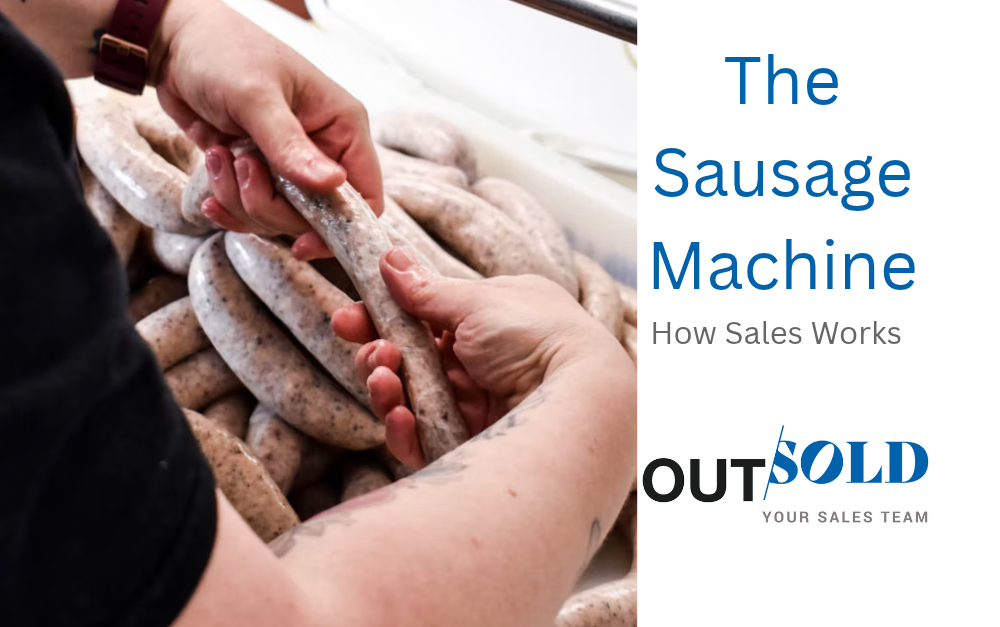
Sales has long been called the sausage machine. I don’t really know the origin of it, but it’s a great analogy. Think about your sales playbook, your sales engine, as the sausage machine, and a bunch of complex sales ideas get a lot easier for people managing sales without a sales background.
So I’m going to explain modern sales the way I’d explain it to a six year old. With a sausage machine.
1. The sausage machine
The sausage machine itself is your playbook, your sales manual, your staff, your pitch, marketing collateral, the process. It’s the HOW. It’s also called the sales pipe or the sales funnel. Mince goes in the top and sausages come out the bottom. Sausages being the sale.
The machine is a fixed cost, and it’s the thing worth investing in when you don’t know how to get sales for your business reliably and repeatably. A six year old will ask why you can’t just throw mince at people and hope. You can, but it’s not a sale. It’s an ingredient called Marketing.
2. The mince is like leads
Mince is a primary ingredient that goes into the machine. It’s what goes in the top. Lead generation, marketing, email campaigns, SEO, branding, PR. These are variable costs. You can put in a little or a lot, which is why it’s the first thing people blame when the sausages are bad.
You can put high quality grass fed beef in the machine, or you can throw in a bunch of scraps and bones. In sales we call this ‘shit in, shit out’.
3. Quality control
Not everything that goes into the machine should. Not everyone is a buyer. Qualifying out bad prospects is checking the mince for worms before it goes in, so you don’t spend the day abusing your machine grinding bones. A real buyer has a need (an empty barbecue), an interest (an appetite) and a budget (a wallet).
You can spend all day selling your roadkill sausages and the sausage machine did its job, but it doesn’t mean anyone wants to eat it.
Hit the phones a hundred times in a day and three people answer: a janitor, a receptionist and a mystery shopper. Not one of them has a barbecue. I would far rather spend the whole day finding five people with a hungry family and a wallet than knock on a hundred doors. Then there are the tyre kickers, who sniff every sausage in the shop and buy none. You are just abusing your machine grinding bones.
4. Inside the pipe
The pipe has stages, and every stage has a jargon name.
Prospecting is the grinder, finding the mince.
Discovery is asking what kind of sausage they like before you make it.
The proposal is the packet with the price on it.
Negotiation is the haggling at the counter.
The close is the till.
Account management is the regulars who come back every Saturday.
Conversion rate is how much of the mince that goes in the top reliably comes out as sausages. The funnel always leaks, so some of it ends up on the floor, which is why pouring in more mince doesn’t fix a slow quarter. You just get a messier floor. And a sausage left sitting in the display goes off, which is why follow up matters.
5. It takes time
You feed the machine mince and nothing comes out. Not yet. It takes time before the sausages come out, and that wait is called sales lag. The sales work you do now shows up in about three months.
It works the same at the other end. Stop putting mince in and you’ll still get sausages for a while, which is how a business can look healthy after sales stops.
It’s also why founder led sales swings between feast and famine. Lots of customers and nobody to make the sausages, or a factory full of staff and nothing in the machine, a direct consequence of how much you fed the machine three months ago. If you want to reliably turn out sausages you need to repeatedly be asking your customers what flavour sausages they want them operating the machine.
Before any of that, someone has to run the machine. Recruiting, onboarding and training a salesperson before they start operating the machine is called sales ramp. It also means the time taken to build a business up from a sole trader. You wait for the ramp, then you wait for the lag. Sausage making takes time.
6. The KPI
After you have put several batches of mince in the machine, you should be able to predict roughly how many sausage links will come out. That’s your KPI. Roughly. I’ve said before that forecasting is impossible, and anyone who guarantees you a number is selling you one piece of the machine. After a few batches you can say, give or take, this much mince makes that many sausages.
7. Multi channel go to market
Put chicken in the machine and you get chicken sausages. Put pork in and you get pork sausages. What you put in decides what comes out. Run more than one flavour through the machine and you’ve got a multi channel go to market, or GTM if you want to sound clever at a barbecue.
The longer you run one flavour down one street, the harder it gets. People get used to the flavour and want something new. Sales is like science, you need to theorise, test, review in repetition. It’s why a single channel eventually dries up.
Some companies get really good at making one flavour of sausage that stands the test of time. Other companies need evolving menus.
8. The sale one inequation
Now the scary bit. The first sale has a disproportionate cost tied to sales lag. At this point the customer acquisition cost, the CAC, is enormous.
Say it costs a million dollars to produce one sausage. The factory, the staff, the set up, the ingredients, the training, the product testing. One sausage is a million bucks. A six year old will say that is a very expensive sausage. But we didn’t build an entire sausage making facility to produce one sausage.
The sale one inequation means making 1 sausage is $1,000,000 but if you run that same machine over 10 years that cost comes down to pennies.
The six year old is right. Back in the real world it’s something like $50K of total commercial spend for a $1K sale, but the feeling is the same.
This is where a common sales tool is used. 3CAC = LTV comes in. On one side we have CAC, what it cost to win the customer, the million dollars. On the other side we have LTV, lifetime value, what that customer is worth to you over the whole time they stay. The usual rule of thumb is that a customer should end up worth about three times what it cost to win them. The first sausage is a disaster. Once the factory is built, every sausage after it carries a lot less of the bill. How long it takes the sausages to earn back the million is the payback period or break even. Don’t judge the machine on the first sausage. The maths is incorrect.
9. Capacity and the fridge
Every machine has a capacity. It can only grind so much mince an hour, and a new machine needs time to warm up. A target set with no regard for headcount or ramp time isn’t a target, it’s a wish. It’s like asking one cold machine for a thousand sausages an hour on day one.
It can’t run on nothing either. A machine with no mince just sits there. This is why sales’ complains of more leads constantly. You may need five thousand prospects, with email addresses and mobile numbers, in the CRM, because at fifty calls a day that’s only a hundred days of work. The CRM is the fridge where the mince is kept. A tidy fridge full of rotten mince is still rotten mince. It just organises the mess into grades of rot.
10. Gary at the end of the machine
At the bottom of the machine a sausage comes out, and there’s a customer waiting. This is Gary. Gary is not a real person.
Most people get this wrong about sales. You can explain the grinder to Gary. The horsepower, the history of the abattoir, all fourteen types of casing. Gary’s eyes glaze over and he leaves, because every feature you recite hands him more mental work. Or you can hand Gary a sausage sample and wait for feedback.
Gary tastes it and says the beef is too salty, but the chicken and cheese sausage was good. That’s an objection, and it’s good news, because Gary is still in the shop and we know what type of sausage to make. This is how market feedback informs product development.
The customer who says nothing has already left. You panic and chase them down the street with a string of sausages in hand, offer half price. Now Gary wonders what’s wrong with the sausage, because a discount tells a hesitant buyer their hesitation was justified. Don’t make it cheaper. Don’t sell sausages. Make sausages people want to buy.
11. The operator
A machine needs an operator. That’s what we identified when we built Outsold. Most of our competition are actually in the business of architecting factories, or detailed ingredient lists, or clever machine engineering. You can have the machine, the recipe and a fridge full of mince, and without someone running it making sure the sausages are coming out, or checking to inform you that an ingredient or cog needs changing, then you only have a piece of the sausage machine.
Outsold is the operator. We can help design the machine and inform you what flavours have the most market appetite but largely speaking we operate the whole machine.
More of this kind of thinking lives at www.outsold.com.au/blogs.
The research behind this
The 3:1 benchmark between customer lifetime value and customer acquisition cost was popularised by David Skok of Matrix Partners in his SaaS Metrics 2.0 writing. He offered it as a guideline for a successful SaaS business, so it works best as a rule of thumb, not a law.


