
According to Google, here are the top ten reasons businesses fail.
- Running out of cash
- No market need
- Flawed or non existent business plan
- Poor financial management
- Weak marketing and customer acquisition
- Ignoring the competition
- Poor leadership and management
- Unsustainable growth
- Failing to innovate and adapt
- Hiring the wrong team
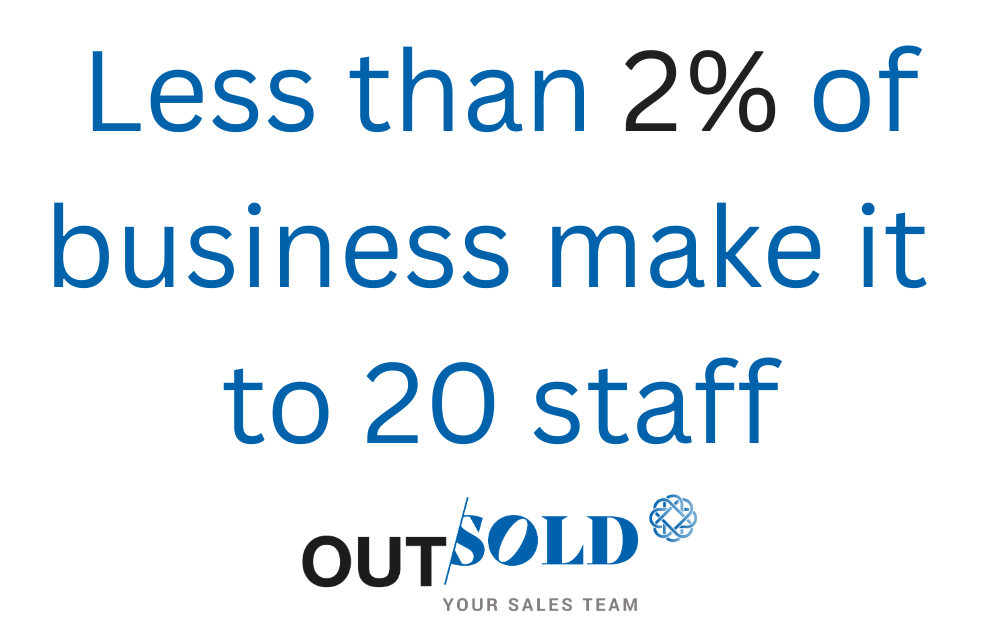
According to me, with more than thirty years in business development, I wholeheartedly agree, and I would throw in that less than two percent of companies actually make it to twenty staff.
Arguably all ten of these are sales problems in disguise, but at least eight of them are, without question, a sales and business development problem. In a nutshell, nearly all businesses that fail, fail because of sales. That makes sense, because line one, sentence one, paragraph one in the book of business is that profit must exceed cost.
In the book The E Myth, the author talks about going from expert to entrepreneur, and how you become a salesperson whether you like it or not. All our lives we build expertise, then we have to metamorphosise into a new version of ourselves. It is a cycle of building up to the best, killing the superego, and birthing a new version of ourselves. That basically means going from youngest to oldest in primary school, then doing the same again in high school, then university, then the workforce, then expert, then small business owner, then medium business owner, then large business owner.
In every vector of life, terminal rank rests on sales skill.
The three choices founders actually have
Essentially, if you want to succeed from sole trader upward, you need to become a student of the game. You have three choices.
Learn sales and do it yourself. This means your day to day will be spent doing sales.
Hire an outsourced sales team Australia businesses actually trust, like Outsold.
Or hire an internal sales and marketing team.
Option one, I recommend, but it hard caps your business somewhere between five and twenty people, because you can only sell what you personally have hours in the day to sell.
Option two, outsourced agency, and yes, of course I have a bias.
Option three is the reason less than two percent of companies succeed, because every founder makes the same mistakes hiring their first sales team. Here are the lessons learned for anyone who wants to avoid the pain of building one from scratch.
The mistakes that sink option three
You hire cheap. They expect you to teach them sales. You expect them to already know sales. Nobody teaches anybody. You can hire low, but only if you already know sales yourself, can produce a repeatable sales playbook, and you are ready to put in a lot of training and management time.
You hire expensive. You allocate the big bucks to bring in a seasoned operator. This also rarely works out, because cost exceeds profit. I wrote a whole blog on why, which you can read here.
All your eggs in one basket. You get one person with one skill set, and customer acquisition now requires a huge range of skill sets.
Audiences are fractured. Go to market needs to be multi channel now. Where do your leads and sales actually come from? Cold calling, Google ads, TikTok shorts? Not knowing your channel or route to market will flatline your sales pipeline and your business.
Most outsourcing sucks. You pay an agency ten grand. You get a useless LinkedIn list or an SEO retainer, twelve leads, or some vanity metric that counts as part of a sale, like being part pregnant.
Founder led sales. You bottleneck your business and white knuckle it through day to day sales. Most founders, if I were hiring them into a sales role, would be a fifty thousand dollar candidate at best. If you have an expertise, you are better off focusing on that. You know your product better than anyone, then you realise you are starting at the bottom again as a sales guy.
Everything lives in their head. No CRM, no process. They leave, and it all leaves with them.
Two reps. You hire a second rep hoping for a bit of competition. They only compete on who can do less. Or you hire a sales person and a marketing person, and they promptly disagree on where the responsibility lies.
Hiring your mate or family. It feels safer. It does not mean they can sell. Now it is awkward to manage them.
Hiring the big resume. Working at a big logo usually means they cannot sell. The logo sold itself.
No ideal customer profile. They show up with no idea who to call, so they improvise, and they burn your best prospects first.
Commission only. You get what you pay for. I get one to three of these requests every day of the week. Unless you can demonstrate a real effort to remuneration ratio, this is just you begging someone to take on all the hard work and risk of building your business and hoping they will do it for free. I told one founder last week that even if he offered me ninety nine percent ownership of his business, it still would not be worth my time.
No ramp time. Sales can take six months to years to bear fruit. You need to understand that sales has a cost and a timeline. It is not free money from day one.
No activity standard. No calls per day, no targets. You do not notice they are underperforming until the pipeline runs dry.
No sergeant. Sales is brutally hard work, and it is easy to slack off in. Who is going to be the bad guy who pushes a salesperson back on the phones after a string of brutal rejections?
This is exactly why the sales outsourcing vs hiring in house decision matters more than most founders realise. It is not a preference. For a business under five staff, it is close to a survival decision.
The maths backs it up
None of this is theory. Add up what a single internal hire actually costs once you include recruitment, background checks, onboarding, superannuation, tools, management time, and the inevitable turnover, and a seventy thousand dollar salary lands closer to two hundred thousand dollars a year in true cost to the business.
A few numbers worth sitting with if you are weighing this up:
- Onboarding a new salesperson averages 38 days and around $9,589 before they have made a single productive call
- An empty sales seat costs the business roughly $20,000 a week in lost revenue while it sits vacant
- The majority of salespeople hired are gone, one way or another, inside their first year
- Most small and medium businesses do not have a defined, repeatable sales process at all, which is exactly what shows up on Google’s list as a flawed business plan and weak customer acquisition
Compare that to an outsourced junior working at a few hundred dollars a day, with no severance, no empty desk risk, and a senior sales manager already built into the arrangement, and the maths stops being close.
So what do you do about it
Every one of the ten reasons businesses fail traces back to a founder who either could not sell, would not sell, or built a sales function badly. That is not an insult. It is just the pattern, repeated across almost every industry I have worked in over thirty years.
If you are a founder led business trying to decide between grinding it out yourself, gambling on an internal hire, or bringing in a team that has already made every one of these mistakes on someone else’s dollar, that decision is worth more thought than most founders give it. It is one of the few sales hiring problems you can actually solve before it costs you a year and two hundred grand finding out the hard way.
If any of this sounds familiar, there is more thinking like this at www.outsold.com.au/blogs.


