
Why Small Businesses Win More Than They Think They Should
Written by Jamie May
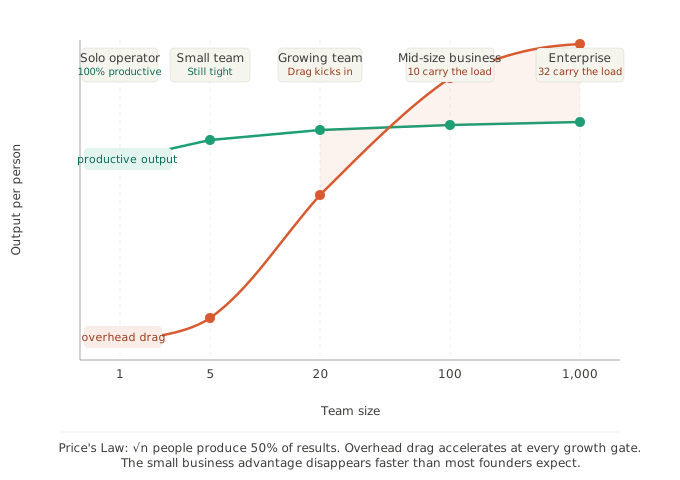
There is a principle in statistics called Price’s Law that does a remarkably good job of explaining something most small business owners feel intuitively but rarely have the language to articulate. It was formulated by a British scientist named Derek Price in the 1960s and it states that in any given field, roughly fifty percent of total output is produced by the square root of the total number of participants.
In plain terms: if you have a hundred salespeople in a company, ten of them are producing half the revenue. If you have a hundred researchers in a field, ten are writing half the papers. Scale up to a thousand participants and the math holds. Thirty-two people producing half the output. The larger the organisation, the smaller the percentage of people carrying the majority of the weight.
That is the theory. Here is why it matters for your business.
Big Does Not Mean Better
The instinct in business is often to equate size with capability. Bigger team, bigger budget, bigger brand. The assumption is that scale produces results, and that a small business is inherently at a disadvantage against a larger competitor.
Price’s Law suggests the opposite is often true. In a large organisation, the productive core is always a fraction of the total headcount. The rest is overhead, administration, internal politics, and the kind of institutional drag that accumulates when businesses grow faster than their culture or their processes. A fifty person business might have ten people genuinely driving outcomes. The other forty are managing the complexity created by having fifty people.
A well-run small business with ten people, where everyone is contributing meaningfully and there is nowhere to hide inefficiency, can outperform that fifty person organisation in almost every dimension that matters to the customer. Speed of decision. Quality of service. Depth of expertise. Clarity of communication. The small business is closer to the core of what it does, and that proximity to the work is a genuine commercial advantage that scale erodes over time.
Staying Small on Purpose
The most interesting application of Price’s Law is not what it says about existing businesses but what it suggests about how to structure one deliberately.
The businesses that consistently punch above their weight are the ones that have found ways to stay operationally lean while accessing the capabilities they need. Outsourcing non-core functions is one of the most direct applications of this thinking. Every function that sits outside your genuine area of expertise is a candidate for outsourcing to someone for whom it is a core competency. Your time and your team’s time is finite and expensive. Spending it on functions where you are average, when you could be spending it on the work where you are exceptional, is a structural inefficiency that compounds over time.
Fractional delivery takes this further. Bringing in a fractional sales director, a fractional CFO, or a specialist in any area to handle specific high-value work, without carrying the cost of a full-time hire, is exactly the kind of resource allocation that Price’s Law points toward. You are accessing the top ten percent of capability in a given discipline without building the overhead of employing the whole distribution. For a growing business that cannot yet justify or afford a full senior leadership team, this is one of the most capital-efficient decisions available.
The same logic applies to outsourced sales teams and outsourced business development. Rather than building an in-house sales function from scratch, with all the recruitment, onboarding, management, and infrastructure costs that entails, a business can access a proven sales capability immediately and allocate its own resources to the product, service, or operational work that is genuinely difficult to replicate.
Proximity Is a Competitive Advantage
One of the most underrated advantages a small business holds over a large competitor is proximity to the customer. Not just in a service sense, though that matters, but in an intelligence sense.
A small business is closer to the market signals that inform good decisions. The founder or the sales lead is often in direct conversation with customers and prospects regularly, which means the feedback loop between what the market wants and what the business does is tight and fast. In a large organisation that same signal has to travel through layers of management, reporting, and internal translation before it influences anything. By the time it does, the market has often moved.
Smaller teams also tend to produce a higher level of customer experience almost by default. The personalisation, the memory of the client’s specific situation, the ability to respond quickly and without bureaucratic friction, these are things that large businesses spend enormous amounts of money trying to engineer back into their customer experience after they have scaled past the point where it happens naturally. For a small business it is simply how things work.
Specialisation as a Trust Builder
There is one more dimension of Price’s Law worth understanding in a sales and marketing context. Specialisation builds trust faster than breadth, and trust is one of the hardest things to manufacture at scale.
A business that does one thing exceptionally well, that has deep expertise in a specific industry, problem type, or customer segment, will nearly always be more credible to a qualified buyer than a generalist operation ten times its size. The prospect can feel the difference between talking to someone who genuinely understands their world and someone who has been briefed on it. That credibility does not require scale. It requires focus.
Cost-efficient marketing and sales follow naturally from genuine specialisation. When you know exactly who your ideal customer is, what their problems are, and what they need to hear to trust you with their business, your lead generation and sales process become dramatically more efficient. You are not casting wide and hoping. You are talking directly to the people most likely to become your best customers, in the language that resonates with their specific situation.
What This Means in Practice
Price’s Law is ultimately an argument for staying focused, staying lean, and being ruthless about where your best people spend their time. The businesses that apply this thinking well are the ones that grow sustainably, maintain strong margins, and build customer relationships that compound over time rather than constantly churning.
For founders and operators thinking about how to grow without losing the qualities that made them effective in the first place, the answer is rarely to hire more people and build more internal infrastructure. It is more often to stay close to the core, outsource intelligently, access fractional expertise where it is needed, and protect the agility and proximity that a small business has and a large one has to work very hard to maintain.
That is a significant part of what we do at Outsold. Outsourced sales, fractional sales management, and B2B lead generation built around the specific needs of a business rather than a generic playbook. The goal is always to give growing Australian businesses access to the top end of sales capability without the overhead of building it entirely in-house.
If that model makes sense for where your business is right now, it is worth a conversation. You can also read more about how we think about sales strategy, outsourced sales in Australia, and building revenue operations that scale intelligently at www.outsold.com.au/blogs.
Jamie May is the Managing Director of Outsold, an Australian founder-led sales agency specialising in outsourced sales teams, fractional sales management, and B2B lead generation across Sydney, Melbourne, and nationally.


