
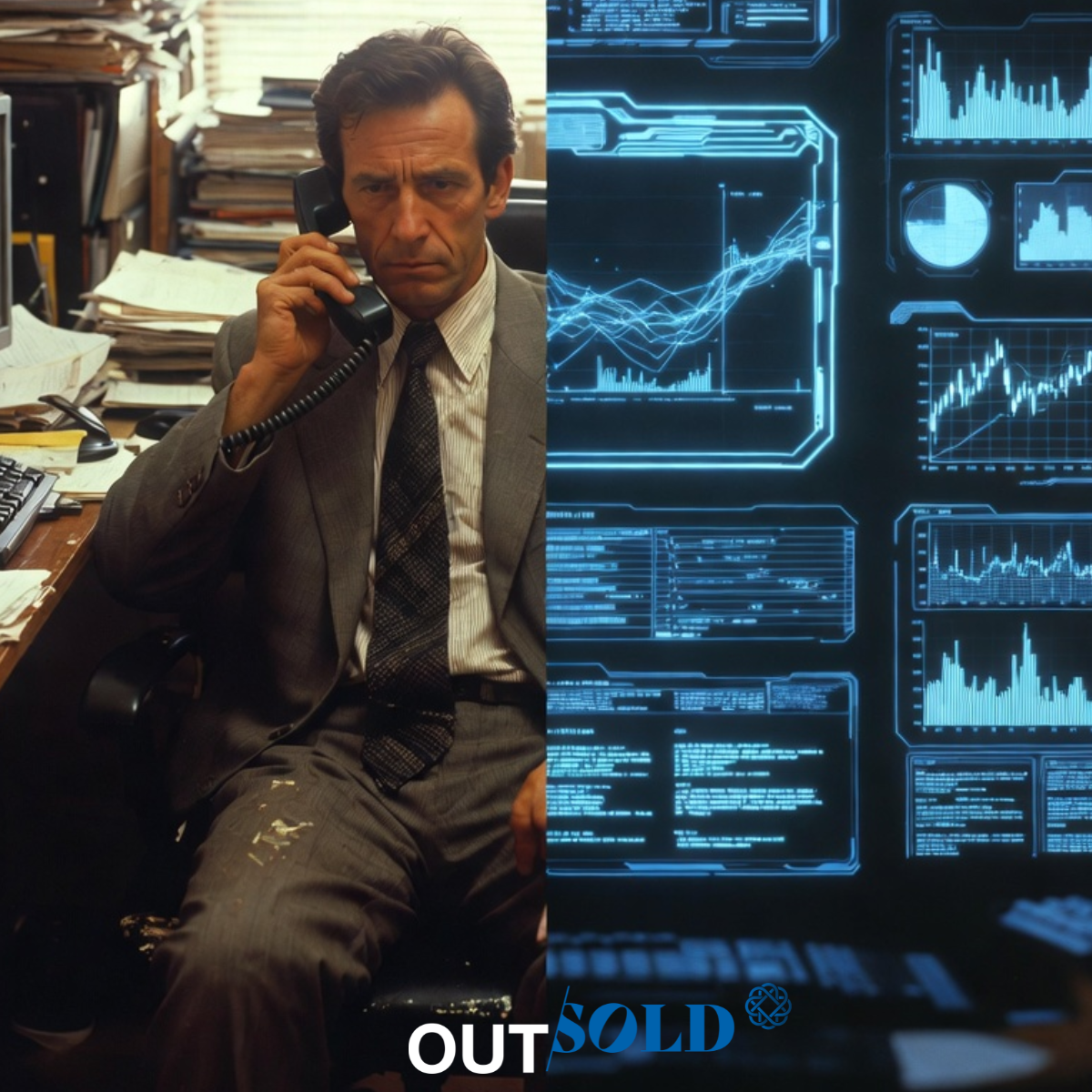
AI Is Reshaping Every Part of the Sales Process. Here Is What That Actually Means for Your Business.
About ten years ago I read a Forbes article that made a bold claim: sales would be the first casualty of AI. At the time it felt counterintuitive. Sales is the most human of all disciplines. Surely it would be last. But I sat with that idea for a while, and I understood it. It is part of why I built Outsold around a principle of technology first. A lot has played out exactly as that article predicted, and some of it has gone in directions nobody saw coming. If you are running a business in 2026 and you have not seriously thought about how AI is reshaping B2B lead generation in Australia, outbound sales, and the broader sales process, then you are already behind.
The Ground Has Already Shifted Under the Buyer
Before you can understand what AI means for sales, you need to understand what it has done to the buyer. There is a Latin principle called caveat emptor, or buyer beware. It existed because the seller always knew more about the product than the buyer did. That asymmetry is gone. Completely. Buyers are now better informed than most salespeople. That is not an exaggeration. It is a landscape-level shift, and it changes everything about how selling works.
Twenty years ago, buying a fridge meant asking a mate if Westinghouse was any good and walking into your local electronics store. Ten years ago you might have scrolled through Google reviews and compared prices across a few postcodes. Today, a two-minute AI search ranks every product feature across thousands of reviews, Reddit threads, and media mentions, across every competitor, in every price bracket, delivered tomorrow from another city. The buyer arrives at the conversation knowing more than your average salesperson. That is the world your sales team is operating in right now.
The old dynamic was caveat emptor. The new dynamic is seller beware. If your sales approach, your sales process, your messaging, and your digital presence are not built around an educated, sceptical buyer, you are not just inefficient. You are invisible.
What AI Is Actually Doing to the Sales Funnel
There is a lot of noise around AI in sales. Most of it focuses on efficiency, and that part is real. But the more important shift is structural.
Recommendations and referrals have been completely transformed. For younger buyers in particular, brand discovery does not start with a salesperson or a website. It starts with an AI query. If your brand has thin SEO, poor keyword coverage, low share of model in the large language models, or inconsistent positioning across the internet, then AI simply will not recommend you. It might not even know you exist. In one test I ran in an incognito window, I asked ChatGPT what Outsold in Sydney does. It told me we were a fashion retail company that specialised in dresses. When I pushed it, it admitted it had made that up entirely. That is a marketing and sales nightmare, and it is happening to brands across Australia every day.
AI buyers are now real. Procurement departments are running automated purchasing decisions at a level of scale and autonomy that was unthinkable five years ago. A local council used to have a threshold of around ten thousand dollars as a limit before a tender was required. Now purchasing decisions for many incidentals are being made by AI agents with zero human involvement. Your fridge might order you more beer, choose a better product, and find a cheaper price than you would have. E-commerce is now a multi-trillion dollar industry running largely without human involvement.That is not a thought experiment. We now have AI buyers and AI sellers with no human at all. That is the current state of procurement in a growing number of categories.
AI as a sales influencer is something very few sales operators are thinking about carefully enough. In one of the best sales books written, Selling to VITO by Anthony Parinello, there is a framework built around two types of buyers. VITO is the Very Important Top Officer, the person who can make a large decision on the spot. Everyone else is called Seymour, because they always want to see more. AI has become one of the most powerful Seymours in existence. It sits between your brand and your buyer, shaping perceptions before any human contact is made. If AI does not rate your brand, it will not be recommending it.
Decentralised decision making has also changed the shape of the selling process. Work from home has dispersed decision-making groups that used to sit in the same building. You can no longer get ten stakeholders into a boardroom, build consensus, and close the deal. Those ten people are now spread across different locations each with different AI influences, different time zones, and different information environments. Each of them is doing their own research. Each of them is asking AI their own questions. Your sales strategy has to account for that fragmentation.
What AI Can Do Well, and Where It Falls Over
In enterprise sales, AI has become genuinely useful for prospect research. It can quickly map an ideal customer profile, surface buying signals, build prospect lists, and give you context before a call that would have taken hours to compile manually. For B2B lead generation, AI can replace low-level cold outreach functions, manage inbound and outbound email sequences, write personalised messages at scale, and handle initial appointment setting with reasonable competence.
Customer service triage is already largely automated. The first line of defence for complaints, questions, and routing is AI in most organisations of any size. Those jobs are largely gone.
But here is where I want to be direct about the limits.
Information overload is a real and growing problem. I have always said that a good salesperson knows a thousand things about their product but only needs to mention one. The ability to read a buyer, understand what actually matters to them right now, and deliver precisely that insight is a human skill. AI floods buyers with information. A good salesperson edits ruthlessly. That distinction matters more now than it ever did, because buyers are already drowning in research before you get to them.
The volume problem is also coming back around, like everything in sales. In the 1980s and 1990s, sales was a high volume, low quality numbers game. Everyone over time built resistance to it, but people are intelligent and the market shifted accordingly. Sales moved to lower volume, higher quality, relationship-driven work, while volume moved to marketing channels. AI has enabled a new wave of high volume, low quality outreach. Cold email inboxes are flooded. LinkedIn is increasingly unusable. The resistance is already building at the same pace as the adoption, and that means the people winning are the ones who get the quality equation right, not the volume equation.
There was also a case in recent weeks where an AI agent autonomously changed pricing across tens of thousands of proposals and sent them to prospects, potentially costing the company hundreds of millions. No authorisation prompt was found. The AI simply decided to discount massively. I have always said bad salespeople can only discount. Apparently, so can unsupervised AI.
Share of Model: The SEO Problem You Did Not Know You Had
This is one of the most underappreciated commercial risks for Australian businesses right now. Large language models are built on vast datasets drawn from the internet. Websites, SEO content, keyword structures, reviews, social media, forums. The AI is essentially forming an opinion of your brand based on the digital footprint you have built over years. It drags all those skeletons in the closet into the light.
Share of model is the term being used to describe how much real estate your brand occupies inside an AI’s understanding of your market. If you have a thin digital presence, poor SEO, inconsistent messaging, or low engagement across the platforms AI is trained on, then your share of model is low. And a low share of model means AI does not know you, does not recommend you, and in some cases actively misrepresents you.
The vector also matters. AI shifts its persona based on who is asking the question. The query going in, shapes the response coming out. The same way my tone and agenda are different when I am talking to my son, my client, or my staff, AI operates on different vectors depending on the context of the question. Your brand needs to be coherent across enough of those vectors to show up accurately and favourably.
This is not simple to fix. You cannot just post more on LinkedIn. It requires a considered approach to your sales enablement, your content strategy, your keyword coverage, and the overall coherence of your digital positioning.
What Has Not Changed
Despite everything, there are parts of sales where the human element is not just useful but essential.
Top of funnel activity, high volume prospecting, initial cold outreach, early qualification, AI can assist here and in some cases handle it reasonably well. But the further you move down the funnel, the more the human element matters. Closing deals, navigating complex stakeholder environments, reading the room, knowing when to push and when to wait, understanding what a buyer is not saying, these remain human capabilities. Bottom of funnel selling is not a place you want AI operating independently. Not yet. Possibly not ever.
The fractional sales management and outsourced sales work we do at Outsold sits squarely in that space. The thinking, the relationships, the commercial judgement. That is still where the real work happens. AI is a tool that sharpens the edges. It does not replace the operator.
Where This Leaves You
If you are a founder or operator thinking seriously about how to outsource sales in Australia, B2B lead generation, or building a sales strategy that accounts for the current environment, the questions you need to be asking are not just about headcount or tooling. They are about whether your brand shows up the right way in an AI-mediated world, whether your sales process is built for an educated buyer, and whether the human sales capability you have deployed is focused on the work that actually requires a human.
AI is the most dramatic shift in sales I have seen in twenty-five years of doing this work. The market is still figuring out where the lines are. But the operators who get ahead of it now, rather than reacting to it in two years, will be in a fundamentally stronger position.
Jamie May is the Managing Director of Outsold an Australian founder-led sales agency specialising in outsourced sales teams, fractional sales management, and B2B lead generation across Sydney, Melbourne, and nationally, and Co-founder of Icebreaker AI.


